


Quartet in Autumn review


Subtle and absorbing adaptation of Barbara Pym’s novel


While her early post-war novels had met with modest success, novelist Barbara Pym was unpublished for 15 years before finally finding recognition with Quartet in Autumn in 1977. The story of four people who work together, but live separate lives alone is penetrating, sad, funny and acutely observant of the nuanced relationships between men and women.
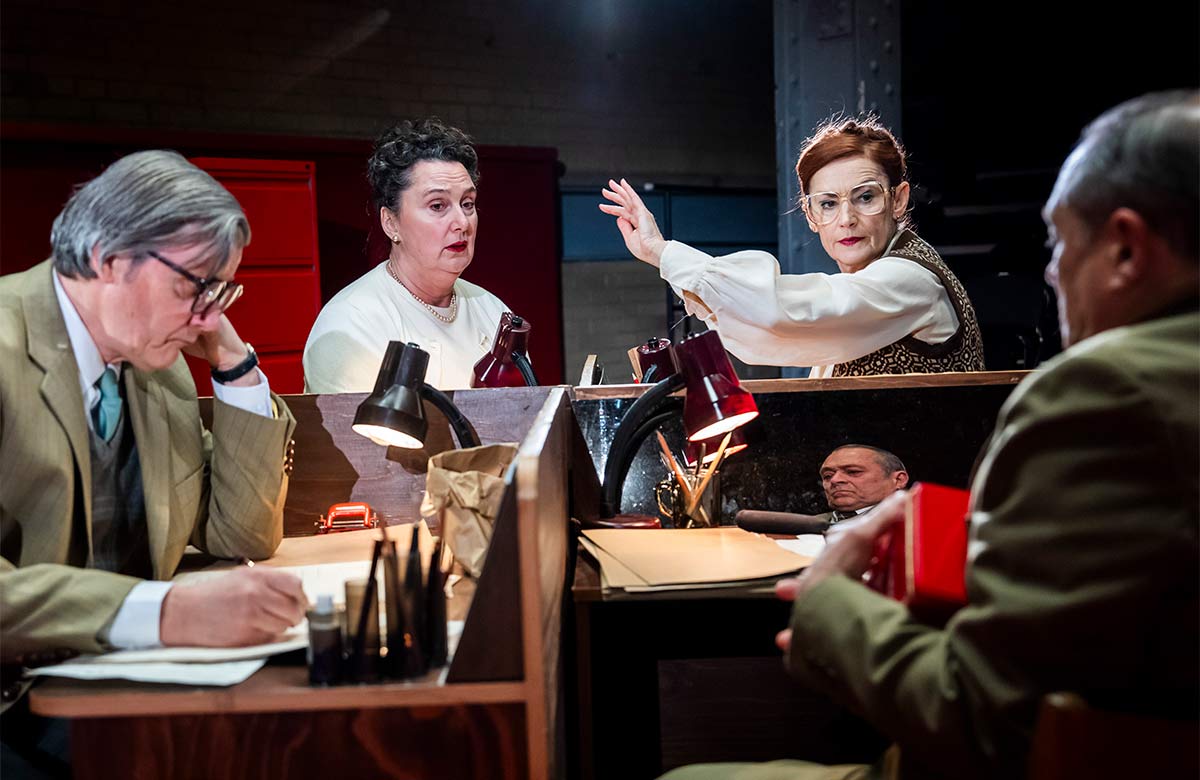
Adaptor Samantha Harvey has caught Pym’s mood and subtle blend of mordant humour and reflective melancholy, and director Dominic Dromgoole delivers an elegant, simple and poised production.
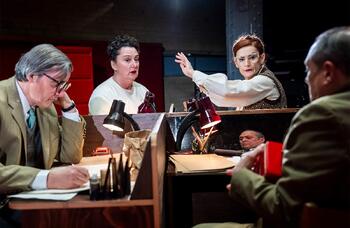
The quartet consists of widower Edwin (Anthony Calf), who has found solace in the church; disappointed spinster Letty (Kate Duchêne); abrasive Marcia (Pooky Quesnel); and crass and cynical Norman (Paul Rider) who “goes around shouting at cars”.
On Ellie Wintour’s design of a central desk divided into a quadrant – reflected by Skylar Turnbull Hurd’s lighting structure above – they fill in forms, while engaging in exquisitely mundane dialogue. Pym observes the minutiae of lives more ordinary than most, particularly those of the women who are verging on retirement. The poignancy of their illusions about how liberating their retirement will be – holidays, travel, culture – is offset by the awareness that without the enforced companionship of work, what little purpose they have will disappear entirely. Virtually nothing happens to disrupt their lives or their work – we have no idea what they actually do and neither, it seems, do they – and the sense of human redundancy scours the stage like Vim.
Continues...
The idea that they are all waiting for something that will never happen conjures the spirit of Beckett’s Vladimir and Estragon (“It’s difficult to keep on,” says Letty), while the mystery of what their work actually entails is benignly Kafkaesque.
All this is staged with the utmost simplicity, lights dimming and rising to change scenes or indicate the passing of time, until Marcia and Letty take their retirement envelopes and they go out for a very awkward lunch. Never having fraternised beyond the office, they are at a loss as to how to communicate in the world outside. All four are heading towards the twilight of their lives and wondering what happened to them, and what they achieved, if anything.
The women, in particular, are in worse shape than the men. Bedsits and uncertain tenancies, few friends or relatives and, in Marcia’s case ill health, a possible mastectomy and an obsession with her consultant – all contribute to the feeling that their inconsequential lives are drawing to a close. Yet such is the strength of Pym’s writing and Harvey’s adaptation that there is rarely a moment when sadness is overwhelming. Fragments of almost surreal humour divert attention away from the abyss – Norman humming the Van der Valk theme tune, which is picked up by the others, a funeral wreath passed from hand to hand, a debate on the components of chicken forestière – ameliorate the miasma of sadness and colour the characters with a defining eccentricity that never descends into caricature.
The performances are superb, although the women have the better roles. Marcia’s decline is the most dramatic, while Letty’s late conversion from hopelessness to a late-flowering optimism is wholly convincing. Subtle, absorbing and deceptive.
For all the latest theatre reviews, sign up to The Stage’s weekly reviews newsletter
More Reviews
More Reviews
Recommended for you
Most Read
Across The Stage this weekYour subscription helps ensure our journalism can continue
Invest in The Stage today with a subscription starting at just £7.99

© Copyright The Stage Media Company Limited 2026


